Oil on the Floor? We Answer 24 Hours a Day
Emergency Leaking Oil Tank Replacement in Levittown, NY
Fast response for tanks that are leaking, seeping, or too corroded to stay in service. Call now and tell us it is an active leak.
What should you do if your oil tank is leaking in Levittown? Stay clear of the tank, do not move or patch it, keep ignition sources away, and call Levittown Oil Tank Services at (516) 927-4356. Emergency calls are answered 24 hours a day: the leak is assessed, the failed tank is drained and removed, and a new Roth or Granby tank restores your heat, often within a day.
24-Hour Emergency Response
Emergency Replacement for Leaking and Failed Oil Tanks
Oil under the tank. A spreading stain on the basement floor. A fuel smell that was not there yesterday. When a heating oil tank starts to fail, waiting makes everything worse: heating oil migrates into concrete, flooring, and soil, and cleanup grows more expensive by the hour. This is the situation our emergency leaking oil tank replacement service exists for.
Call (516) 927-4356 any hour and tell us the tank is leaking. We treat active leaks differently from routine work: the immediate condition is assessed first, the failing tank is stabilized and taken out of service, remaining oil is pumped out safely, and a replacement tank is planned and installed so your heat comes back quickly.
Do not move, strike, or attempt to patch a compromised tank, and keep ignition sources away from the area. A tank that is seeping at one seam is usually thin in other places too, and rough handling can turn a slow leak into a flood. Describe what you see from a safe distance: whether oil is dripping or pooling, whether the tank is indoors or outdoors, roughly how much fuel it holds, and whether your heating system is running.
Know the Warning Signs
When an Oil Tank Becomes an Emergency
Active Leaks and Fresh Oil
Visible dripping, oil pooling beneath the tank, spreading wet areas, or oil collecting at a fitting or seam mean the tank is failing now. Say "active leak" when you call so the response matches the urgency.
Severe Rust and Structural Failure
Deep flaking corrosion, damp rust blisters along the bottom, weakened legs, or a bulging wall mean the tank should not be relied on for another season, even if oil is not yet on the floor. Failing tanks rarely announce a schedule.
Strong Heating Oil Odor
A sudden or persistent fuel smell can come from the tank, a fitting, the fuel line, or an older spill. The source needs to be found, not assumed. If the odor is strong or paired with visible oil, treat it as urgent.
Sudden Loss of Tank Integrity
A tank knocked off its legs, damaged during other work, or exposed by flooding needs immediate professional attention even when no leak is visible yet.
From Failing Tank to Restored Heat
An emergency replacement compresses the important decisions into the right order; it does not skip them. Once the leak is controlled and the old tank is safely out of service, the replacement still gets planned properly: correct tank size, sound placement, solid supports, and protected piping. The goal is a home that is safer after the emergency than it was before, with a new tank that will not repeat the old one’s failure.
- Immediate assessment of the leak, remaining fuel, and surroundings
- Failed tank drained, disconnected, and removed safely
- Replacement tank installed with heat restored as fast as the job safely allows
- Clear communication about any conditions that need other qualified professionals
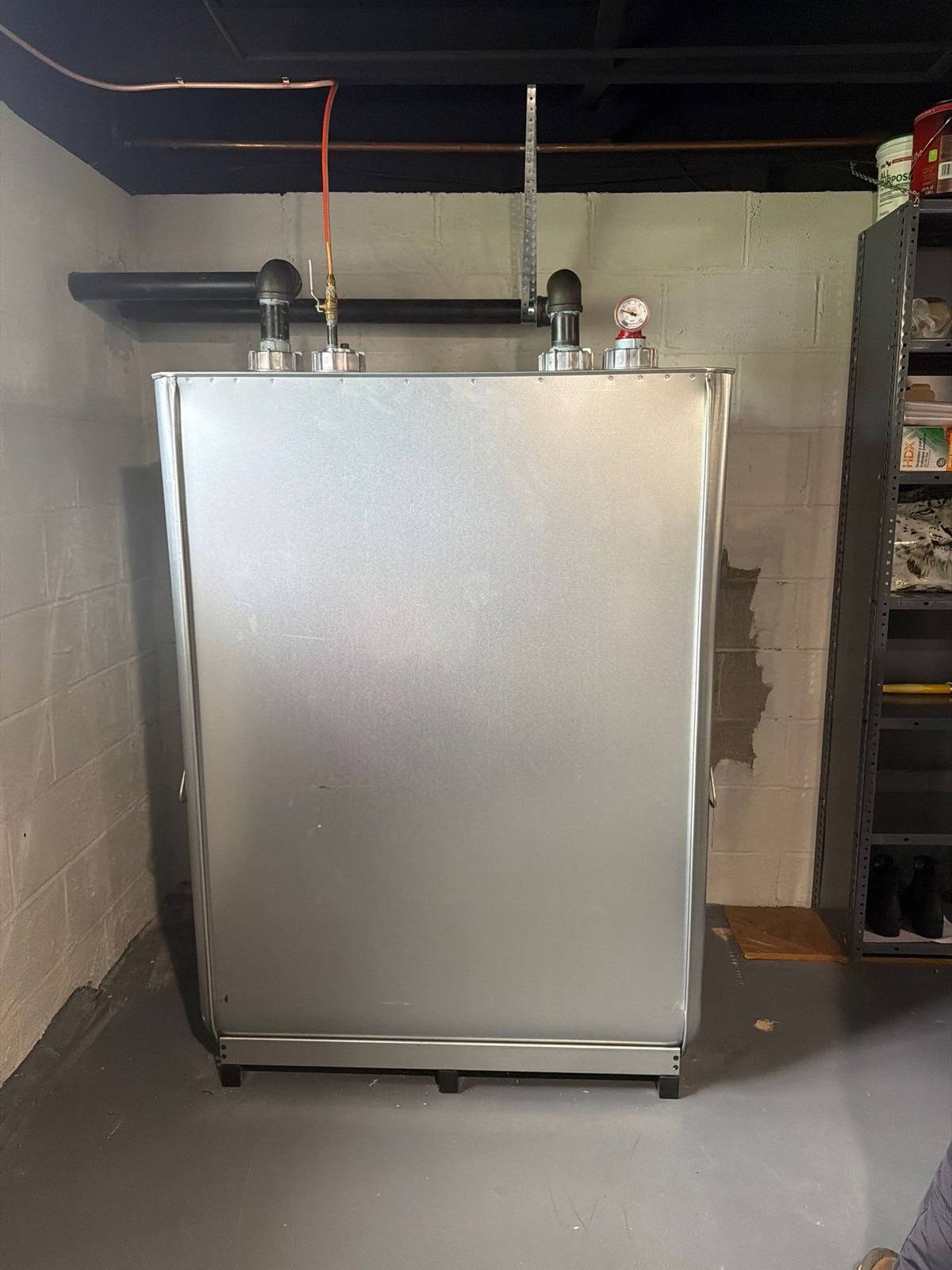
After the Emergency
A finished emergency swap: failed steel tank out, new tank set, connected, and back in service.
If the Tank Leaked: Soil Testing and Remediation
Not every failed tank contaminates the ground, but when there is a chance it has, guessing is not an option. A soil sample from beneath the tank goes to an independent laboratory for confirmation. While results are pending, the excavation is lined with commercial-grade sheeting to mark the tank depth and safely backfilled, so the property stays usable instead of sitting as an open hole.
If contamination is confirmed, the affected soil is excavated and disposed of properly. The ground is screened on site as digging progresses and the result is verified with final laboratory testing, so the cleanup ends with proof rather than assumptions. We also prepare the DEC and town paperwork that documents the remediation from first sample to final clearance, one of the most valuable pieces of paper a property can have at its next sale.
- Independent laboratory analysis, never in-house guesswork
- Excavation lined and secured while results are pending
- Contaminated soil removed and disposed of at approved facilities
- On-site screening plus final lab verification of the cleanup
- DEC and town documentation handled start to finish
How an Emergency Tank Replacement Unfolds
Call and Describe the Leak
Where the tank is, what you see and smell, roughly how much oil it holds, and whether the heat is running.
Stabilize the Situation
The tank’s condition, remaining fuel, and surroundings are assessed and the immediate risk is brought under control.
Remove the Failed Tank
Oil is pumped out and the compromised tank is disconnected and removed according to its condition.
Install and Restore Heat
The replacement tank is installed with proper supports and piping, and your heating system is returned to service.
Emergency Oil Tank Questions
What should I do first if my oil tank is leaking?
Stay away from the tank, do not try to move or patch it, and keep flames and ignition sources out of the area. Then call (516) 927-4356 and say clearly that the tank is actively leaking. That single sentence moves your call to the front of the line.
Is a leaking oil tank an emergency?
Yes. Heating oil spreads into concrete, flooring, and soil quickly, and cleanup costs climb with every hour the leak continues. A tank that has started to seep can fail suddenly, so treat visible oil, fresh staining, or a strong fuel smell as urgent.
Do you offer 24-hour emergency oil tank service?
Yes. Leaking and failed tanks are handled with 24-hour emergency availability. Call (516) 927-4356 any hour and describe what you are seeing.
Can a leaking oil tank be repaired instead of replaced?
Patching a corroded steel tank is at best a short-lived gamble, because a tank leaking in one spot is usually thinning in others. Replacement is almost always the sound answer, and it removes the risk instead of postponing it.
How fast can a failed oil tank be replaced?
Emergency replacements are prioritized, and many are completed within a day once the situation is assessed, keeping your home without heat for as short a time as possible. Access and site conditions affect the timeline, and we tell you what to expect immediately.
Will my heating be off during the replacement?
Briefly, yes. The old tank must be taken out of service before the new one is connected. We sequence the work to restore your heat as quickly as the job safely allows.
Leaking Tank? Call Now.
Say "active leak" and we will treat your call with the urgency it deserves, 24 hours a day, across Levittown and central Nassau County.
Emergency Tank Replacement Across Central Nassau County
We respond to leaking and failed oil tanks in Levittown and these nearby communities.